Benthic surveys have also been conducted in efforts
to see why this area is important to sea turtles. The
area is a mixture of dense seagrass, seagrass with
occasional soft corals and sponges, and patch reefs
with large massive starlet corals.
Coral reef studies have identified reefs in the "12
Foot Bank" area of Robinson Point to support
"resilient reefs." These resilient reefs lie adjacent
areas where we target turtle capture. The green
turtles captured here sleep under these large corals
heads.
to see why this area is important to sea turtles. The
area is a mixture of dense seagrass, seagrass with
occasional soft corals and sponges, and patch reefs
with large massive starlet corals.
Coral reef studies have identified reefs in the "12
Foot Bank" area of Robinson Point to support
"resilient reefs." These resilient reefs lie adjacent
areas where we target turtle capture. The green
turtles captured here sleep under these large corals
heads.
| Turtle Projects |
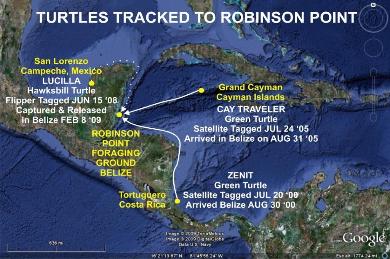
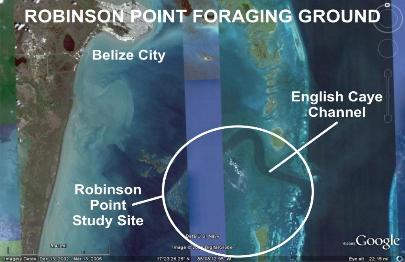
The Robinson Point area has been an historically
important turtle fishing and foraging ground since
the1700s. Treaties were signed between Spain and
England allowing turtle fishing between the Northern
and Southern Triangles. The Northern Triangles refers
to Chinchorro Bank in Mexico and the Southern
Triangles refers to the islands that make up Robinson
Point.
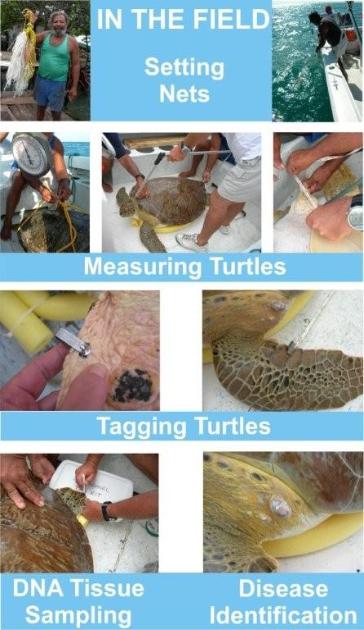
The Robinson Point Turtle Project employs ex-turtle
fishermen for making nets, capturing turtles and
assisting scientists in gathering data from the turtles
captured. The fishermen are learning important
conservation techniques, while helping scientists
determine the importance of this area to sea turtles in
the Wider Caribbean.
Data that results from these surveys include
information on population abundance, size class,
genetic history and health of turtles. It is hoped that
one day the Robinson Point area can be Belize's first
Turtle Sanctuary.
important turtle fishing and foraging ground since
the1700s. Treaties were signed between Spain and
England allowing turtle fishing between the Northern
and Southern Triangles. The Northern Triangles refers
to Chinchorro Bank in Mexico and the Southern
Triangles refers to the islands that make up Robinson
Point.
The Robinson Point Turtle Project employs ex-turtle
fishermen for making nets, capturing turtles and
assisting scientists in gathering data from the turtles
captured. The fishermen are learning important
conservation techniques, while helping scientists
determine the importance of this area to sea turtles in
the Wider Caribbean.
Data that results from these surveys include
information on population abundance, size class,
genetic history and health of turtles. It is hoped that
one day the Robinson Point area can be Belize's first
Turtle Sanctuary.
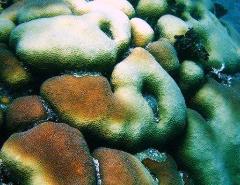
Benthic surveys have also been conducted in efforts to
see why this area is important to sea turtles. The area is a
mixture of dense seagrass, seagrass with occasional soft
corals and sponges, and patch reefs with large massive
starlet corals.
Coral reef studies have identified reefs in the "12 Foot
Bank" area of Robinson Point to support "resilient reefs."
These resilient reefs lie adjacent to areas where turtles
are targeted for capture. The green turtles captured here
sleep under these large corals heads.
see why this area is important to sea turtles. The area is a
mixture of dense seagrass, seagrass with occasional soft
corals and sponges, and patch reefs with large massive
starlet corals.
Coral reef studies have identified reefs in the "12 Foot
Bank" area of Robinson Point to support "resilient reefs."
These resilient reefs lie adjacent to areas where turtles
are targeted for capture. The green turtles captured here
sleep under these large corals heads.
| Project Overview |
| What Attracts Turtles to Robinson Point? |
 |  |  |  |  |  |
17 Princess Margaret Dr. LF, PO Box 1234, Belize City, Belize
TEL: + (501) 671-3483, FAX: +(501) 223-7007
Email: linda@REMOVEecomarbelize.org, www.ecomarbelize.org
TEL: + (501) 671-3483, FAX: +(501) 223-7007
Email: linda@REMOVEecomarbelize.org, www.ecomarbelize.org
 |  |  |  |  |  |
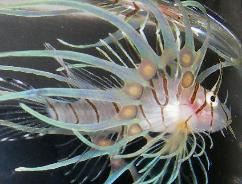


| Conservation through Education! |
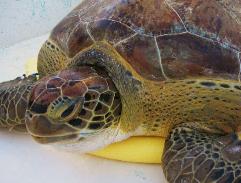
| Resilient Reefs |
| ECO/ECOMAR is a charitable company registered under the laws of Belize. If you would like to help support any of our projects please make a donation today! |

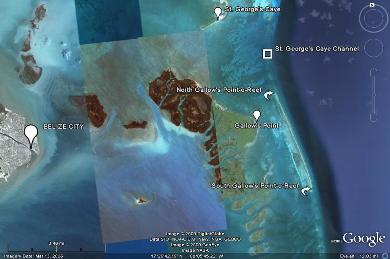
The Gallow’s Point Turtle Project was launched on Aug
27, 2009 in conjunction with a film crew working on a
new series for the Animal Planet. The following are
reasons why Gallow’s Point was chosen as an expansion
to turtle research ECOMAR already conducts at
Robinson Point.
• After more than a decade of diving and snorkeling
on the Gallow’s Point Reef and observing numerous
turtles, this study was launched to determine the
importance of the reef system to sea turtles.
• After more than one year of surveying in the
Robinson Point area no juvenile turtles were
encountered and this project was initiated in efforts to
identify habitat for juvenile turtles.
• We have access to the area at minimum 3/week
which will allow repeated surveys to be conducted.
Gallow’s Point Reef is roughly 9-10 miles east of Belize
City. The Gallow’s Point Reef stretches four miles from
the channel at St. George’s Caye southwards to South
Gallows. This reef supports a myriad of wildlife
including endangered species such as the sea turtles and
manatees. There is a well developed reef crest and
associated spur and grooves in the fore reef zone.
Leeward of the reef crest are extensive stands of sea
grass beds which support juvenile queen conch and
traditional lobster fishermen who set traps. In the fore
reef, traditional sailboat fishermen are often sighted
hunting for lobster, conch and finfish.
27, 2009 in conjunction with a film crew working on a
new series for the Animal Planet. The following are
reasons why Gallow’s Point was chosen as an expansion
to turtle research ECOMAR already conducts at
Robinson Point.
• After more than a decade of diving and snorkeling
on the Gallow’s Point Reef and observing numerous
turtles, this study was launched to determine the
importance of the reef system to sea turtles.
• After more than one year of surveying in the
Robinson Point area no juvenile turtles were
encountered and this project was initiated in efforts to
identify habitat for juvenile turtles.
• We have access to the area at minimum 3/week
which will allow repeated surveys to be conducted.
Gallow’s Point Reef is roughly 9-10 miles east of Belize
City. The Gallow’s Point Reef stretches four miles from
the channel at St. George’s Caye southwards to South
Gallows. This reef supports a myriad of wildlife
including endangered species such as the sea turtles and
manatees. There is a well developed reef crest and
associated spur and grooves in the fore reef zone.
Leeward of the reef crest are extensive stands of sea
grass beds which support juvenile queen conch and
traditional lobster fishermen who set traps. In the fore
reef, traditional sailboat fishermen are often sighted
hunting for lobster, conch and finfish.
GALLOW'S POINT TURTLE PROJECT
| North Gallows |
South Gallows
| Project Overview |
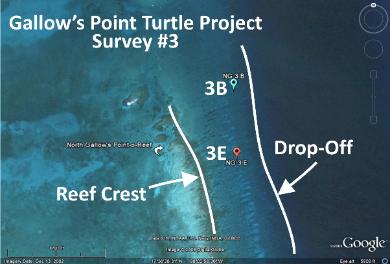
reef at Gallows Point. During the first survey we at
about 35 feet, west towards the reef crest where the
water depths are about 20 feet depth . The depths
near the drop-off were too deep for our team to be
able to swim down and capture any turtles and so
subsequent surveys were located in shallower waters
of 15-25 feet. Figures 2 and 3 present Three snorkel
surveys were conducted along the fore locations of
snorkel surveys conducted at Gallow’s Point Reef.
The beginning point of a survey is indicated with a
“B” and the end of the survey is indicated with an
“E.” Our first and second surveys were interrupted by
a large series of thunderstorms and rain that passed
over around midday and so the number of surveys we
could conduct was limited by poor weather
conditions.
The one day survey at Gallow’s Point Reef was very
successful. A total of 8 turtles were sighted, 7 of
which were hawksbills and 1 was a loggerhead. No
green turtles were observed on this date, but they
have been sighted by divers so it is expected that
they will be encountered on future snorkel surveys.
Five turtles observed were juvenile hawksbills, and
one was an adult hawksbill and one an adult
loggerhead. One juvenile hawksbill turtle was
captured, measured, tagged and released.
ECOMAR thanks BIO Recon Productions for funding
the first survey of the Gallow’s Point Turtle Project
and the following participants of this important first
survey: John Searle, Sergio Hoare, Jose Munoz,
Ernesto Reid and Paul Hyde.
about 35 feet, west towards the reef crest where the
water depths are about 20 feet depth . The depths
near the drop-off were too deep for our team to be
able to swim down and capture any turtles and so
subsequent surveys were located in shallower waters
of 15-25 feet. Figures 2 and 3 present Three snorkel
surveys were conducted along the fore locations of
snorkel surveys conducted at Gallow’s Point Reef.
The beginning point of a survey is indicated with a
“B” and the end of the survey is indicated with an
“E.” Our first and second surveys were interrupted by
a large series of thunderstorms and rain that passed
over around midday and so the number of surveys we
could conduct was limited by poor weather
conditions.
The one day survey at Gallow’s Point Reef was very
successful. A total of 8 turtles were sighted, 7 of
which were hawksbills and 1 was a loggerhead. No
green turtles were observed on this date, but they
have been sighted by divers so it is expected that
they will be encountered on future snorkel surveys.
Five turtles observed were juvenile hawksbills, and
one was an adult hawksbill and one an adult
loggerhead. One juvenile hawksbill turtle was
captured, measured, tagged and released.
ECOMAR thanks BIO Recon Productions for funding
the first survey of the Gallow’s Point Turtle Project
and the following participants of this important first
survey: John Searle, Sergio Hoare, Jose Munoz,
Ernesto Reid and Paul Hyde.
